Natural Dye & Fabric Printing Since 1996
Where colour meets cloth, one motif at a time
A complete, technically reviewed guide to fabric printing with natural dyes — how block, screen, digital and resist printing work, the nine-stage natural dyeing process, and how to choose the right approach for your textile line.
0
Years of Dye Craft
0
Core Printing Methods
0
Step Natural Process
0
Countries Exported To
The Basics
What fabric printing actually is
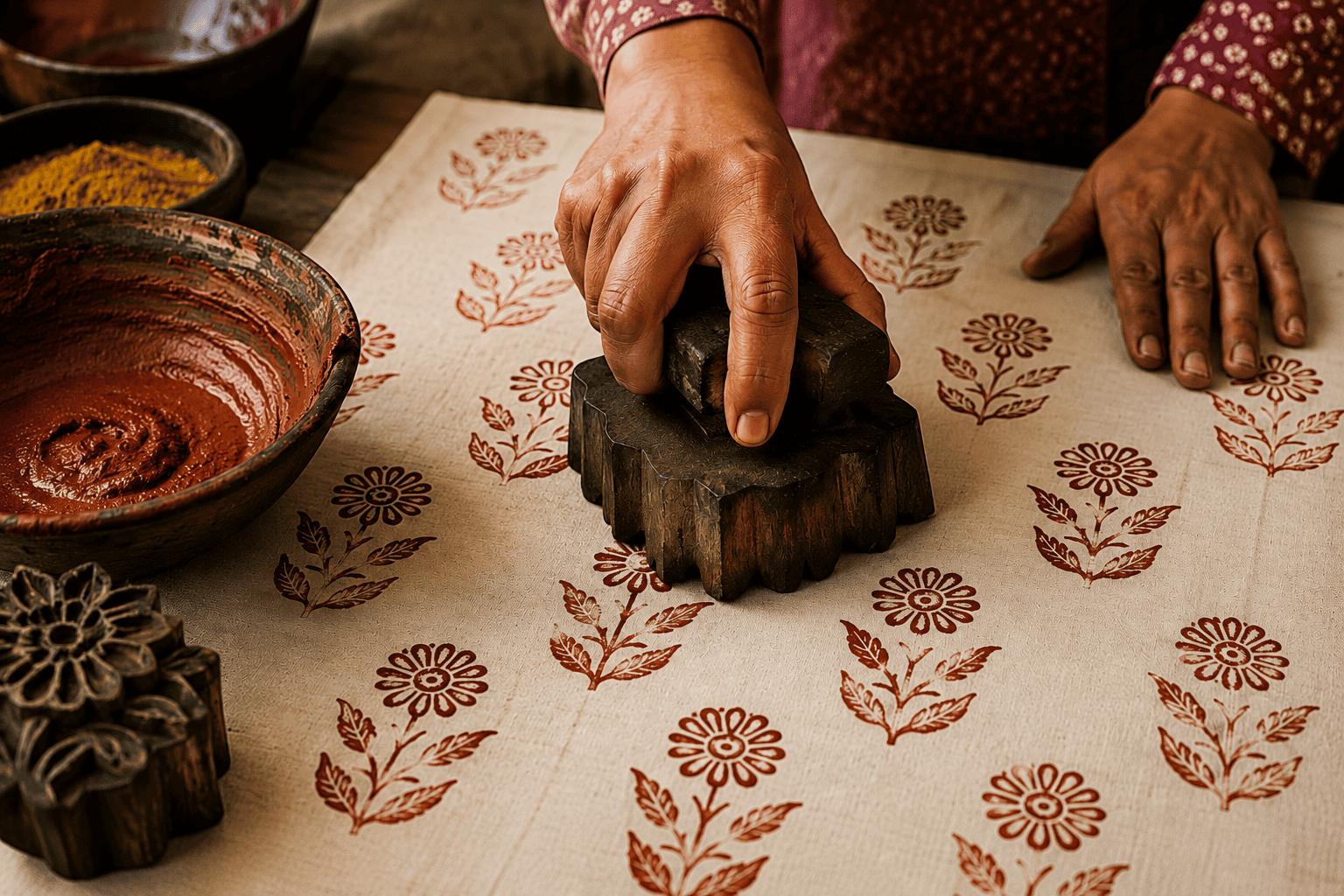
Fabric printing places colour exactly where a design calls for it, rather than saturating the whole cloth. A carved block, a mesh screen, a wax resist, or a computer-guided nozzle deposits pigment only on chosen areas, leaving the rest of the weave untouched. The result is a motif — a paisley, a geometric grid, a floral trail — sitting on the surface of the fabric rather than soaking through it uniformly.
Every printed textile carries a story behind its pattern: a regional craft tradition, a folk motif passed through generations, a strict geometric repeat, or a modern abstract composition drawn straight from a designer's sketchbook. That narrative is part of what makes printed fabric feel considered rather than mass-produced. Explore our guide to natural dye manufacturing in India for the sourcing side of this story.
- Colour is applied only where the design calls for it, not across the whole cloth
- Works with carved blocks, mesh screens, wax resists or digital printheads
- Multiple colours and motifs can share a single piece of fabric
- Carries regional craft traditions and generational design language
Comparison
Fabric printing vs. fabric dyeing, side by side
These two finishing techniques are often confused, but they solve different design problems and suit different production goals.
| Aspect | Fabric Dyeing | Fabric Printing |
|---|---|---|
| Colour coverage | Entire fabric, uniformly | Only the design area |
| Best for | Solid-colour yardage and garments | Motifs, logos, patterns, artwork |
| Process | Whole cloth immersed in dye bath | Paste applied via block, screen or resist |
| Colour count | Typically one shade per run | Multiple colours on one fabric |
| Visual result | Flat, consistent tone | Layered, patterned, textural |
Heritage
A craft older than recorded history
Hand-applied fabric printing predates industrial machinery by millennia. Early civilisations across India, China, Egypt and Persia independently developed methods for pressing colour onto cloth using carved stamps, resists and mineral pigments — long before a single printing press existed.
India in particular built a reputation for printed cotton so distinctive that it became a major export commodity, reaching markets across Asia, Egypt, Greece and Rome through ancient trade routes. That same lineage of hand-block and resist printing survives today, now adopted by sustainability-focused fashion labels seeking an alternative to synthetic, high-water-use processes — many of which now rely on natural dye manufacturers like AMA Herbal for consistent supply. Read more in our Natural Dye Blog.
Ancient IndiaAncient EgyptAncient PersiaAncient China
Methods
Four ways to print a fabric
Each printing method suits different fabrics, order volumes and design complexity. Here is how the four core techniques compare.
01
Block Printing
The oldest surviving printing technique. A design is hand-carved into wood or metal, dipped in dye, and pressed onto fabric one motif at a time — making every printed length genuinely one-of-a-kind.
Ethnic wearScarves & stolesHome furnishings
02
Screen Printing
A stencil is fixed onto a fine mesh screen laid over the fabric. A roller forces dye through the open areas of the stencil, leaving the shielded fabric uncoloured — ideal for repeatable, bulk-scale output.
T-shirtsWestern apparelBulk productionMerchandise
03
Digital Printing
A CAD-guided printer sprays pigment directly onto the fabric surface with no physical stencil or block required, allowing complex, photographic and gradient designs at speed.
SportswearSynthetic fabricsPromotional apparel
04
Resist Printing
Wax, clay or a resinous paste blocks dye from penetrating chosen areas of the cloth before the fabric is dyed. Once the resist is removed, those protected zones stay uncoloured, forming the pattern. Batik is the best-known resist technique.
BatikArtisan textilesLayered patterns
Every method pairs differently with natural dyes — we'll help you match technique to fabric.
Get Method Guidance
The Process
How fabric is printed with natural dyes, step by step
Natural dye printing rewards patience. Because plant and mineral colourants behave less predictably than synthetic pigments, every one of these nine stages needs careful, hands-on attention.
1
Choosing the Fabric
Organic cotton, linen, hemp, silk, wool or bamboo fabric — each fibre takes natural colour differently, so the base cloth is chosen to match the desired shade and hand-feel.
2
Readying the Fabric
The cloth is thoroughly scoured to strip away manufacturing residue, oil, wax and dirt so the surface can absorb dye evenly.
3
Mordanting
A mordant — a tannin-rich plant extract, mineral salt, or naturally derived chemical — is applied to help the dye bond permanently, directly shaping the final colour and its wash-fastness.
4
Preparing the Natural Dye
The raw dye source is washed, broken down, soaked, fermented, boiled or filtered as needed until it yields usable liquid colourant.
5
Preparing the Printing Paste
Liquid dye is combined with a natural binder and thickener — commonly a vegetable gum — to form a paste that will hold its shape on the fabric surface.
6
Printing the Design
The paste is applied using carved wooden blocks, mesh screens, or hand painting for smaller runs. Precise registration between colours is the difference between a crisp motif and a blurred one.
7
Drying
Printed lengths are air-dried on open lines. A slow, natural drying period lets the pigment settle uniformly rather than pooling unevenly.
8
Fixing the Colour
Heat and steam are applied, followed by additional natural mordanting, to lock the colour permanently into the fibre.
9
Washing & Finishing
A final gentle wash removes excess dye before the fabric is dried, ironed and trimmed — finishing with the soft, characterful texture natural printing is known for.
Want a technical data sheet for this exact process?
Request Technical SheetWhy Choose Natural
Benefits of natural dye fabric printing
These advantages apply across our full natural red dye, natural yellow dye and natural green dye ranges.
Eco-Friendly
Mostly biodegradable and generally lower in polluting run-off than synthetic dyeing, when processed without excess chemical additives.
Gentle on Skin
Free of many harsh synthetic colourants, making naturally dyed fabric a comfortable choice for sensitive skin — though specific plant allergies are always worth checking.
Sustainable Sourcing
Most dye-producing plants grow abundantly or can be cultivated repeatedly, supporting long-term, renewable supply chains.
Preserves Tradition
Continues centuries-old printing crafts, sustaining artisan communities whose skills would otherwise fade under fully automated production.
Distinctive Colour
Soft, layered, earthy tones with a depth and character synthetic pigments rarely replicate.
Lower Petrochemical Load
Depending on the associated manufacturing process, reduces overall reliance on petroleum-derived dye chemicals.
See how these benefits translate to your product line.
Discuss Your FabricApplications
Where naturally printed fabric shows up
Fashion houses, home decor brands and conscious apparel labels increasingly favour natural dye printing for both its aesthetic and its lower environmental footprint. See more applications of natural dyes across the textile industry, or browse our Natural Dye Guide for fibre-specific advice.
- Dresses
- Sarees
- Kurtas
- Baby clothing
- Stoles & scarves
- Cushion covers & curtains
- Bedding
- Gifting accessories
Case Study
Scaling block printing without losing its soul
"AMA Herbal's natural dye consistency across large print runs let our mill move traditional block printing into export-scale production without losing colour depth."
— Global Textile Processors Association
3×Faster Batch Turnaround
98%Shade Consistency
0Synthetic Additives
Buying Guide
Natural dye printing compared
A closer look at how natural dye printing stacks up against synthetic and alternative methods, to help mills and brands choose the right approach for a given order.
Natural Dye vs. Synthetic Dye
| Aspect | Natural Dye | Synthetic Dye |
|---|---|---|
| Source | Plants, roots, minerals, insects | Petrochemical derivatives |
| Biodegradability | Generally biodegradable | Often persistent in wastewater |
| Colour palette | Earthy, nuanced tones | Bright, highly consistent shades |
| Batch consistency | Requires skilled monitoring | Highly repeatable |
| Skin sensitivity | Generally gentler | Can trigger sensitivity in some users |
Block Printing vs. Screen Printing
| Aspect | Block Printing | Screen Printing |
|---|---|---|
| Production speed | Slow, hand-applied | Fast, mechanised |
| Uniqueness | Every piece slightly unique | Highly repeatable design |
| Best volume | Small batch, artisan runs | Bulk, export-scale runs |
| Typical use | Ethnic wear, stoles, home decor | T-shirts, western apparel, merchandise |
Natural Dye vs. Pigment Printing
| Aspect | Natural Dye | Pigment Printing |
|---|---|---|
| Bonding method | Absorbed into fibre via mordant | Sits on fabric surface with binder |
| Hand-feel | Soft, breathable finish | Can feel stiffer on heavy coverage |
| Wash durability | Good with correct mordanting | Can crack or fade with heavy washing |
Natural Dye Printing vs. Digital Printing
| Aspect | Natural Dye Printing | Digital Printing |
|---|---|---|
| Design complexity | Best for motifs and repeats | Handles photographic detail easily |
| Setup | Blocks or screens required | No physical stencil needed |
| Fabric fit | Natural fibres | Synthetic and blended fabrics |
Natural Dye Source Comparison
| Source | Colour | Typical Use |
|---|---|---|
| Indigo | Blue | Denim, block printing |
| Madder (Rubia) | Red / Rust | Block & screen printing |
| Turmeric | Yellow | Cotton & silk printing |
| Marigold | Yellow | Home furnishings |
| Henna | Olive / Brown | Resist & block printing |
Colour Fastness Comparison
| Test | Well-Mordanted Natural Dye | Unmordanted Natural Dye |
|---|---|---|
| Wash fastness | Good to very good | Poor, fades quickly |
| Light fastness | Moderate to good | Poor |
| Rub fastness | Good | Fair to poor |
Fabric Compatibility
| Fabric | Natural Dye Uptake | Best Printing Method |
|---|---|---|
| Cotton | Excellent | Block, screen, resist |
| Silk | Excellent | Block, hand painting |
| Linen | Very good | Block, screen |
| Hemp | Good | Block printing |
| Wool | Good | Resist, hand painting |
| Polyester / synthetic blends | Poor | Digital printing (with synthetic pigment) |
Still unsure which comparison applies to your order?
Ask Our Technical TeamInteractive Tool
Natural Dye Selector
Answer four quick questions and get a natural dye recommendation suited to your fabric and production goals.
Select your options above and click "Get Recommendation" to see a suggested natural dye.
Quality & Trust
Manufacturing standards behind every batch
Batch-Level QCEvery dye lot tested for shade and fastness
Since 1996Three decades of natural dye manufacturing
Export ReadyDocumentation for international mills
Technical SupportApplication guidance from our own team
40+ Export CountriesNatural dyes shipped worldwide
500+ Clients ServedTextile mills and dyeing houses globally
Industrial CapacityScaled production for bulk export orders
In-House Research TeamOngoing R&D on extraction & mordanting
Lab-Tested CertificationsShade cards & fastness reports on request
Global Supply ChainReliable export documentation & logistics
Need documentation for a specific certification or export market?
Ask About CertificationsQuestions, Answered
Frequently asked questions
Fabric printing is the controlled application of colour to selected areas of a textile to form a pattern, rather than colouring the entire cloth. It's used to create motifs, logos and decorative designs on garments and home textiles. See our full breakdown of what fabric printing actually is above.
Dyeing immerses the whole fabric in colourant to produce a single solid shade. Printing applies colour only where the design calls for it, allowing multiple colours and patterns on a single piece of cloth. Compare both directly in our comparison tables.
Organic cotton, linen, hemp, silk, wool and bamboo fabric absorb natural colourants most effectively, since their natural fibres bond well with plant and mineral-based dyes. Try our Natural Dye Selector for a tailored recommendation.
Yes — fabrics printed with natural dyes are generally gentle on skin, since they avoid many synthetic petrochemical colourants. Individuals with specific plant allergies should still check the exact dye source used.
Largely, yes. Natural dye printing is biodegradable and renewable when the dye plants are sustainably cultivated and processed without excess chemical additives — making it a lower-impact alternative to many synthetic processes. See our full list of benefits.
Natural dyes tend to produce rich, earthy, nuanced tones rather than neon-bright shades. Some sources can achieve vivid colour, but naturally printed fabric is generally valued for its soft, sophisticated palette.
Mills and dyeing houses can contact AMA Herbal directly to request lab samples, technical data sheets, shade cards and bulk export pricing for natural dyes suited to fabric printing. Visit our contact page to get started.
Related question: What is the shelf life of natural dye printing paste?
Prepared printing paste is generally best used within a few days of preparation, since natural colourants can shift in tone or lose potency once mixed with binder. Our technical team can advise on batch timing for larger production runs — see the preparing the printing paste step above.
Continue Reading
Related products & guides
From the Blog
Related articles & guides
Explore more on natural dyeing, garment dyeing and sustainable textile production from the AMA Herbal Natural Dye Blog.
Dye Guide
Natural Indigo: A Complete Guide
Everything about indigo extraction, shade development and application.
Dye Guide
Natural Yellow Dye Sources Explained
Turmeric, marigold and pomegranate compared for textile use.
Dye Guide
Natural Green Dye for Textiles
How leafy-plant extracts produce stable green and olive tones.
Dye Guide
Natural Brown Dye: Catechu & Walnut
Earthy brown tones from catechu, walnut husk and tea.
Process
Garment Dyeing with Natural Colour
How finished garments are dyed rather than dyeing yarn or fabric.
Product
Liquid Indigo for Denim Manufacturing
A ready-to-use indigo format built for rope- and slasher-dyeing lines.
Product
VegeBact: Natural Antimicrobial Finish
A plant-based finish that pairs with naturally dyed textiles.
Product
Formaldehyde-Free Durable Press Finish
A safer wrinkle-resistant finish for naturally printed fabric.
Scientific References
Further reading & scientific sources
- Textile Exchange — Preferred Fiber & Materials Market Report
- Global Organic Textile Standard (GOTS) — GOTS Certification & Labelling
- OEKO-TEX — STANDARD 100 Testing Criteria
- Better Cotton — Better Cotton Standard
- USDA Agricultural Marketing Service — Organic Textiles Guidance
- ScienceDirect — Extraction of Eco-Friendly Natural Dyes and Biomordants for Textile Coloration: A Critical Review
- Springer Nature — Natural Dyes in Textile Printing: Parameters, Methods, and Performance
- MDPI (Molecules) — Advancements in Sustainable Natural Dyes for Textile Applications: A Review
Content Integrity
Written & reviewed by our technical team
Fact-Checked by AMA Herbal Technical Team
A
Author: AMA Herbal Editorial Team
Compiled from three decades of in-house dye application and printing experience.
R
Reviewed by: AMA Herbal Technical Team
Natural dye specialists and textile application experts working with these processes in active production, not outside content writers.
Company Expertise
Manufacturing natural dyes and supporting fabric printing operations since 1996 — three decades of hands-on production experience. Learn more about AMA Herbal.
Research Methodology
Content is cross-checked against in-house lab data, application trials, and established textile references before publication.
Editorial Policy
All technical claims are reviewed by practicing dye specialists, not third-party content writers, and updated as production knowledge evolves.
Last Reviewed
This page was last reviewed for accuracy on by the AMA Herbal Technical Team.
Stay Connected
Stay Updated with Natural Dye Innovations
Subscribe to the AMA Herbal newsletter to receive the latest natural dye research, sustainable textile innovations, product launches, technical articles, industry news, and expert insights directly in your inbox.
Ready When You Are
Bring natural colour to your next fabric run
Whether you're testing block printing on organic cotton or scaling resist printing for export, our team can help you get the shade, fastness and volume right.
Need natural dye samples?
Inquire Now